 |
|
Stabilize deteriorated paint
Once you have identified deteriorated paint, it must be repaired. It is the responsibility of the property owner to:
 |
Protect the residents and their belongings |
| |
Repair substrate damage |
| |
Repair the paint |
| |
Conduct cleanup |
| |
Other LBP-related concerns |
| |
Obtain clearance (if deteriorated surface is more than the de minimis) |
Repair substrate damage
Repairing substrate damage includes problems such as:
| |
Dry rot |
| |
Rust |
| |
Other components that are not securely fastened |
| |
Crumbling plaster |
| |
Missing siding |
| |
Moisture damage |
Prior to repainting the surface of a damaged substrate, the cause of the damage must be repaired. The surface must be prepared to receive the new paint.
If the area is smaller than the de minimis level, the preparation should include:
| |
Surface preparation (wet sanding or scraping is still recommended to minimize the release of dust) |
| |
Cleanup using conventional cleaning methods |
| |
The key to the preparation is to minimize the amount of dust released |
If the area is larger than the de minimis level, this preparation must include safe work practices:
| |
Wet sanding or wet scraping |
| |
Protection of the worksite to keep lead dust from leaving the worksite or getting onto the resident's belongings |
| |
Cleaning of the worksite with HEPA vacuuming and detergents |
Other LBP-related concerns
In addition to deteriorated paint, you should look for paint chips or other paint debris. If you see any evidence that work was performed but not cleaned up, you should ask the property owner to clean up the debris
| |
This cleanup should include misted sweeping and damp mopping to remove dust and debris |
| |
Cleaning work areas will help reduce the risk of lead poisoning. |
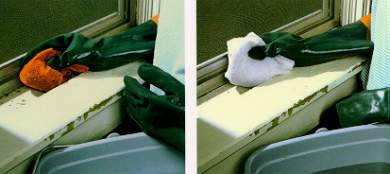
Obtain clearance
A clearance exam might be required once the paint is stabilized.
| |
Clearance examinations include both a visual investigation to identify paint chips and/or dust in the worksite and the collection and analysis of dust-lead samples.
| |
Dust-lead samples are collected using a dust wipe of floor and window surface
|
|
| |
Clearance sampling must be performed by an individual who is authorized by the EPA regulations
| |
Lead-based paint inspectors, risk assessors, and sampling/clearance technicians may conduct a clearance examination
|
|
| |
If the area of paint which was stabilized exceeds the de minimis levels, a clearance examination must be performed in each worksite/area where the work was performed.
| |
If the area did not exceed the de minimis levels, no clearance is required. |
|
Click the Right Arrow to continue


|
![[Logo: Homes and Communities: U.S. Department of Housing and Urban Development]](http://www.hud.gov/images/common/hgv-bnr-logo2.gif)

![[Vea la versi�n en espa�ol de esta p�gina]](http://www.hud.gov/images/common/hgv-bnr-espanol2.gif)
![[Contact Us]](http://www.hud.gov/images/common/hgv-bnr-contactus.gif)
![[Display the text version of this page]](http://www.hud.gov/images/common/hgv-bnr-text.gif)
![[Search/Index]](http://www.hud.gov/images/common/hgv-bnr-search.gif)


![[The U.S. government's official web portal]](http://www.hud.gov/images/common/hgv-tpc-usagov.gif)


![[logo: Fair Housing and Equal Opportunity]](http://www.hud.gov/images/common/hgv-icn-fheo.gif)
![[Logo: HUD seal]](http://www.hud.gov/images/common/hgv-icn-seal.gif)