Identify Deteriorated Paint
The first step in conducting a visual assessment is to identify
deteriorated paint. Below is a list of steps in this process.
 |
Define deteriorated paint |
| |
Identify deteriorated paint |
| |
De minimis levels |
| |
Identify surfaces where deteriorated paint is commonly found |
| |
Practical Exercise |
Define "deteriorated paint"
The HUD regulation defines deteriorated paint as:
"Any interior or exterior paint or other coating that
is peeling, chipping, chalking or cracking, or any paint or coating
located on an interior or exterior surface or fixture that is otherwise
damaged or separated from the substrate."
How to identify deteriorated paint
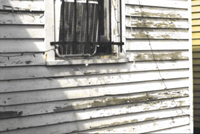 |
To identify deteriorated paint, you will need to answer this question
Is the paint peeling, chipping, chalking or cracking?
If the answer to this question is yes, then the paint should be
considered deteriorated.
De minimis levels
When performing a visual assessment, you will not be asked to identify
tack or nail holes, small hairline cracks or other surface imperfections
that are stable since the paint will most likely not be damaged.
However, if the size is larger than a nail hole or hairline crack,
you should consider the paint to be deteriorated.
How small is too small?
HUD has identified size thresholds for how the repairs must be
made, these thresholds are known as de minimis levels.
It is important to note that de minimis levels control how
a repair must be made, not whether the repair is made. As always,
if deteriorated paint is identified, it must be repaired.
Click the Right Arrow to continue


|
![[Logo: Homes and Communities: U.S. Department of Housing and Urban Development]](http://www.hud.gov/images/common/hgv-bnr-logo2.gif)

![[Vea la versi�n en espa�ol de esta p�gina]](http://www.hud.gov/images/common/hgv-bnr-espanol2.gif)
![[Contact Us]](http://www.hud.gov/images/common/hgv-bnr-contactus.gif)
![[Display the text version of this page]](http://www.hud.gov/images/common/hgv-bnr-text.gif)
![[Search/Index]](http://www.hud.gov/images/common/hgv-bnr-search.gif)


![[The U.S. government's official web portal]](http://www.hud.gov/images/common/hgv-tpc-usagov.gif)


![[logo: Fair Housing and Equal Opportunity]](http://www.hud.gov/images/common/hgv-icn-fheo.gif)
![[Logo: HUD seal]](http://www.hud.gov/images/common/hgv-icn-seal.gif)