 |
|
De Minimis Levels Defined
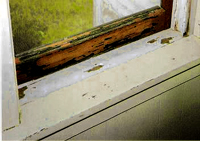
If more than ten percent (10%) of the total surface area of an interior or exterior type
of component with a small surface area is deteriorated, the de minimis level has been
exceeded. Examples would be window sills, baseboards, and trim.
Exterior de minimis levels
The de minimis level is 20 square feet for exterior surfaces.
 |
This means a total of 20 square feet on all the exterior
surfaces |
| |
This includes outbuildings, fences, and play equipment
attached to the
land and belonging to the owner |
| |
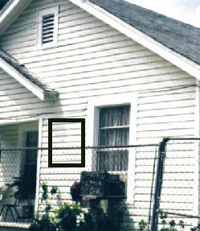
Twenty square feet is a square about 4 feet 6 inches on
each side (about the size of the square shown on the photo) |
If all the deteriorated paint on all of the building components is
larger than the square, safe work practices and clearance must be performed.
Interior de minimis levels
The de minimis level is two square feet in any one interior room
| |
This means a total of 2 square feet of deteriorated paint
on the floors, walls,
and ceiling in the room. |
| |
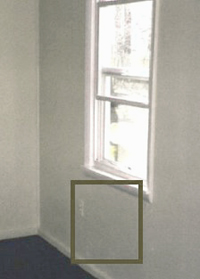
Two square feet is a square about 17 inches on each
side |
| |
If all of the deteriorated paint on all of the building
components is larger
than the square, safe work practices and clearance must be performed |
Examples of de minimis levels
Consider an interior room with 50 linear feet (if you measured the total length
of all the walls in the room) and a baseboard that is 6 inches tall. Suppose the deteriorated area was 6 by 12 inches in size, would that exceed the deminimis level? The answer is no. The deteriorated area does not exceed ten percent of the total area. Here are the calculations:
| |
Total area:
50 feet x 6 inches (0.5 feet) = 25 square feet total area |
| |
Calculate ten percent of the total area:
25 square feet x 0.1 = 2.5 square feet |
| |
Deteriorated area:
6 inches (0.5 feet) x 12 inches (1 foot) = 0.5 square feet |
Since the deteriorated surface area (0.5 square feet) is less than ten percent of the total
area (2.5 square feet) and less than 2 square feet, the area does not
exceed the de minimis level.
Identify areas where deteriorated paint is common
You should look for deteriorated paint on all painted building components, especially any exterior and interior walls, windows, or trim damaged from a roof or plumbing leak.
Also look on surfaces that experience friction or impact
| |
When two surfaces slide across each other or strike one another, the painted surface may become deteriorated |
| |
Examples of friction and impact surfaces are doors, windows, floors, and trim areas |
Click the Right Arrow to continue


|
![[Logo: Homes and Communities: U.S. Department of Housing and Urban Development]](http://www.hud.gov/images/common/hgv-bnr-logo2.gif)

![[Vea la versi�n en espa�ol de esta p�gina]](http://www.hud.gov/images/common/hgv-bnr-espanol2.gif)
![[Contact Us]](http://www.hud.gov/images/common/hgv-bnr-contactus.gif)
![[Display the text version of this page]](http://www.hud.gov/images/common/hgv-bnr-text.gif)
![[Search/Index]](http://www.hud.gov/images/common/hgv-bnr-search.gif)


![[The U.S. government's official web portal]](http://www.hud.gov/images/common/hgv-tpc-usagov.gif)




![[logo: Fair Housing and Equal Opportunity]](http://www.hud.gov/images/common/hgv-icn-fheo.gif)
![[Logo: HUD seal]](http://www.hud.gov/images/common/hgv-icn-seal.gif)